As an Amazon Associate this site earns from qualifying purchases.
Specs at a glance
| Model | Capacity | Max stated output | Cables / ports | Weight | Size | Price |
|---|---|---|---|---|---|---|
| OHOVIV 50000mAh 4-Cable Battery Pack | 50,000mAh | 22.5W PD, QC4.0 | 4 built-in (iPhone, USB-C, Micro, USB-A) + 3 ports (2 USB-A, 1 USB-C); 6 devices at once | 1.07 lb | 5.82 × 2.83 × 1.18 in | Check price on Amazon |
| INIU 10000mAh 45W | 10,000mAh | 45W | 0.4 ft detachable braided USB-C cable | Not stated | Not stated | Check price on Amazon |
| BLAVOR Solar Power Bank 10,000mAh | 10,000mAh | 20W USB-C | USB-C in/out, wireless charging, 3 devices at once | Not stated | Not stated | Check price on Amazon |
| Zmmyuluo 10000mAh 4-Cable | 10,000mAh | Not stated | 4 built-in cables (iOS, USB-C, Micro) + 2 external ports; 5 devices at once | 189 g | 4.41 × 2.8 × 0.7 in | Check price on Amazon |
| VEGER Power Bank with Wall Plug | 10,000mAh | Not stated | Built-in AC plug + 2 cables (iOS, USB-C/Micro) + USB-C and USB-A ports; 4 devices at once | 8 oz | 0.72 in thick | Check price on Amazon |
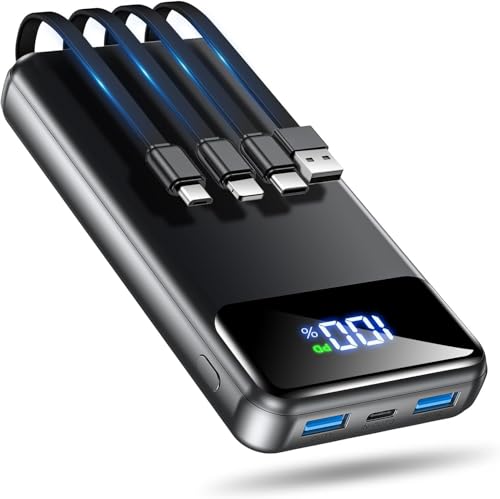
- Huge Capacity 50000mAh Power Bank:OHOVIV Portable charger ultra-high massive capacity provides 10 charges for iPhone 15, which make of new high-density polymer battery.Depending
- Charge 6 Devices at Once: OHOVIV 50000mah Portable phone charger with 4 Built-in Cables(for iPhone, Type-C, Micro, USB-A) and 3 Charging ports (2 USB-A , 1 Type-C), you can charge
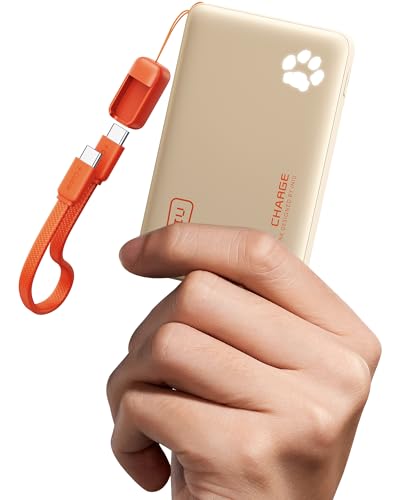
- 40% Smaller & Lighter Portable Charger: Powered by the industry’s first TinyCell high-density battery technology, this ultra-compact 10,000mAh portable charger power bank is 40%
- 45W Pro Speed Portable Phone Charger: This 45W fast charger boosts an iPhone 17 Pro Max to 76%, a Galaxy S25 Ultra to 84%, or an iPad Pro to 60% in just 30 minutes (charging from
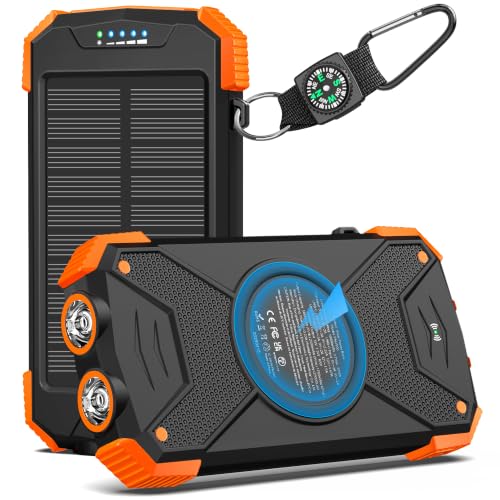
- Brand-Oriented and Outdoor Charger Pro: With over 10 years of experience in solar power banks, BLAVOR has already gained the favor and trust of millions of global users. BLAVOR
- Leading USB C Input Output Tech and Wireless: The latest upgrade includes a USB-C output with 20W fast charging capability, which can charge your iPhone 15 to 65% in just 30
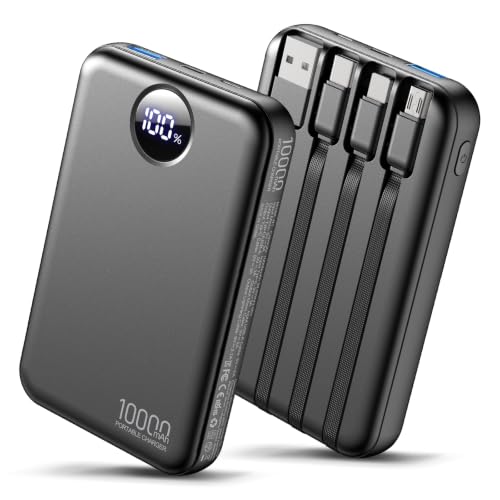
- 10,000mAh Power Bank with 4 Built-in Cables: Stay powered throughout the day with a 10,000mAh portable charger featuring 4 built-in cables for iOS, USB-C, and Micro USB devices
- Ultra-Compact & Lightweight Design with High-Density Battery Technology: Experience powerful charging in a smaller, lighter body. Featuring advanced high-density battery
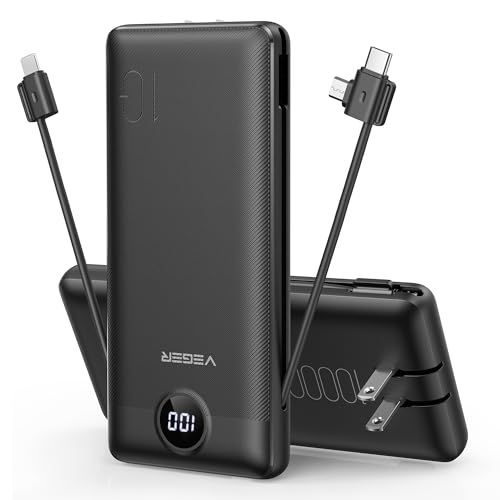
- All-in-One Design: Built‑in AC plug and 2 cables (iOS + USB‑C/Micro USB) eliminate the need for extra adapters or cords. Recharge the power bank directly from wall outlet, and use
- Charge 4 Devices at Once: No more choosing which device gets juice first. The portable charger is able to charge your phone, tablet, earbuds, and smartwatch at once– keep
How to Choose a Power Bank Charger for Your Cell Phone
Quick answer: For most people, a 10,000mAh power bank with a 20W–45W output is the sweet spot — it's pocketable, airline-friendly, and gives a modern phone roughly two full charges. Go bigger (like a 50,000mAh brick) only if you're charging several devices for days without an outlet, and pick a built-in-cable model if you constantly forget cords. Below is a spec comparison of five options and honest notes on who each one actually suits.
Specs above come from each listing. Anything the seller didn't state is marked "Not stated" rather than guessed at.
Capacity: what the numbers actually mean for your phone
Capacity is the headline number, and it's the one most likely to mislead you. Real-world output is always lower than the printed mAh because of voltage conversion losses, so treat manufacturer "X full charges" claims as an optimistic ceiling.
Finding the right power banks charger for cell phones comes down to matching the features to how you will actually use it.
Here's what the listings themselves claim. The Zmmyuluo says its 10,000mAh charges an iPhone 16 up to 2.2 times and a Samsung S24 up to 1.8 times. VEGER says its 10,000mAh gives an iPhone 17/16 nearly two full charges (1.8x) and a Samsung S25 about 1.6x. BLAVOR describes its 10,000mAh as "real-rated" and claims 2.2 charges for an iPhone 14 Pro. INIU says roughly two full smartphone charges. Those numbers cluster tightly, which tells you something useful: at this capacity tier, capacity isn't the differentiator. Speed, cables, and size are.
The OHOVIV sits in a different category entirely at 50,000mAh, with a claimed 10+ charges for an iPhone 15. That's a genuinely different use case — not a daily carry, but a base camp battery.
Charging speed: the spec that changes your day
Output wattage determines how long you're tethered. The INIU leads here at 45W, with the listing claiming an iPhone 17 Pro Max reaches 76%, a Galaxy S25 Ultra 84%, or an iPad Pro 60% in 30 minutes (from 20%). That's fast enough to make a coffee-break top-up genuinely meaningful, and enough headroom for a tablet or handheld console.
The BLAVOR states 20W USB-C, claiming an iPhone 15 to 65% in 30 minutes. The OHOVIV lists 22.5W PD with QC4.0, claiming 55% on an iPhone in 30 minutes. The Zmmyuluo and VEGER listings don't state an output wattage at all — which, if speed matters to you, is itself a data point worth weighing.
Who a compact 10,000mAh charger is for
- You want something that lives in a jacket pocket or small bag without announcing itself.
- You need one or two emergency top-ups per day, not multi-day autonomy.
- You fly. All the 10,000mAh units here are well under the 100Wh TSA carry-on threshold; the INIU and Zmmyuluo listings call this out explicitly.
- You value fast charging over raw reserve. A 45W 10,000mAh unit will get you back to usable faster than a slow 50,000mAh brick.
Who should skip the compact option
- You're off-grid for days. Camping trips, festivals, long power outages, or group travel where four people need charging. A 10,000mAh unit will be flat by day two. The OHOVIV 50,000mAh exists for exactly this, at the cost of 1.07 lb in your bag.
- You charge a laptop. Nothing here advertises a laptop-class output. 45W is the highest stated figure, and only the INIU states it.
- You want a battery that lives on your desk. If it never leaves the house, a wall charger is cheaper and faster than any of these.
- You need wireless charging or solar. Only the BLAVOR lists wireless charging and a solar panel among these five.
The honest trade-offs
Built-in cables cut both ways. The Zmmyuluo, OHOVIV, and VEGER all include built-in cables, which is fantastic until one frays. INIU makes this argument directly in its own listing — it uses a detachable 0.4 ft braided USB-C cable specifically so a broken cord doesn't retire the whole battery. OHOVIV counters that its cables are rated for over 10,000 bends. Both positions are reasonable; pick based on how hard you are on gear.
Big capacity costs you portability. 50,000mAh at 1.07 lb and 1.18 inches thick is not a pocket item. Compare that to the VEGER at 0.72 inches and 8 oz, or the Zmmyuluo at 189 g.
Solar is a supplement, not a power source. The BLAVOR's solar panel is a genuine feature for camping — it also lists dual flashlights, flame-retardant ABS/PC housing, and waterproof silicone — but a small panel trickles. Charge it from USB-C before you leave and treat sun as backup.
More simultaneous devices means slower charging for each. The OHOVIV's six-device claim and VEGER's four-device claim are about convenience, not speed. Splitting output across ports means everything charges slower.
The wall plug is underrated. The VEGER has a built-in AC plug, meaning it recharges straight from an outlet with no separate brick or cable. If you travel light, that's one fewer item to lose in a hotel room.
What to check on the listing before you buy
Listings change constantly, so verify these yourself at the moment of purchase:
- Current price. Every price above is a snapshot. These fluctuate, and coupons appear and vanish.
- Which variant is selected. Many power bank listings share a page across capacities, colors, and cable types. Confirm the dropdown matches what you want before checkout.
- Warranty terms and seller. Check who's actually shipping it and what coverage is offered — this is stated on the product page, not in any article.
- Cable connector type. If your phone is Lightning and the built-in cable is USB-C, that's a problem. Read the connector list carefully.
- Recent customer reviews. Read them yourself, filtered to the most recent, and look for repeated mentions of the specific issue you'd care about (capacity fade, cable failure, port looseness).
- Airline rules if flying, since watt-hour limits and carry-on requirements are set by the airline and regulators, not the seller.
Consider instead if…
- You want maximum speed in a small package: the INIU 45W has the highest stated output here and a replaceable cable.
- You want days of power for a group: the OHOVIV 50,000mAh with four built-in cables and three ports.
- You're spending time outdoors: the BLAVOR solar bank with wireless charging, dual flashlight, and a rugged case.
- You want the lowest price with cables included: the Zmmyuluo at $19.99 with four built-in cables and an LED percentage display.
- You hate carrying a wall adapter: the VEGER with its integrated AC plug.
FAQ
How many mAh do I actually need for a phone? For one or two full top-ups a day, 10,000mAh is plenty — all four 10,000mAh models here claim roughly 1.6x to 2.2x a modern flagship. Step up only if you're charging multiple devices or going multiple days without an outlet.
Can I take a power bank on a plane? Lithium batteries must go in carry-on, not checked luggage, and airlines cap capacity by watt-hours. The INIU and Zmmyuluo listings both note compliance with the under-100Wh carry-on guideline. Confirm your specific airline's policy before you fly.
Is a built-in cable better than carrying my own? It's a convenience-versus-durability trade. Built-in cables (OHOVIV, Zmmyuluo, VEGER) mean nothing to forget; a detachable cable (INIU) means a broken cord doesn't kill the battery. Choose based on your track record with cables.
Does higher wattage damage my phone? No — your phone negotiates the charging rate it will accept, so a 45W bank won't force 45W into a device that tops out lower. BLAVOR's listing specifically claims zero damage to devices with its 20W output.
Related guides
- Editorial Policy: How We Research and Review Power Banks
- How JoltCell Researches Products
- Privacy Policy: How We Handle Your Data
Key Takeaways
- Choosing the right power banks charger for cell phones means matching the key features to your specific needs and budget
- Read real customer reviews and check the return policy before you commit
- Compare value across models — the priciest option is not always the best fit